
We Didn’t Lose Them Overnight. We Lost Them Months Ago.
That surprise resignation of your most productive surgeon, the community’s most beloved pediatrician, or the rising star you were sure would be your next nursing leader felt like it came out of nowhere.
In reality, it was building – quietly, invisibly, inevitably – for months.
The physician who stopped staying late to help the team after being asked too many times.
The nurse who cut back to part-time “just for now.”
The service line where patient complaints ticked up before anyone connected the dots.
And then, eventually, the engagement survey lands in our inbox.
By then, we’re too late.
The Problem Isn’t That Surveys Lack Value. It’s That They Arrive After the Damage Is Done.
We use engagement surveys because they’re familiar. They’re benchmarked. They give us something concrete to point to in board meetings. And we had nothing else.
But let’s be honest about what they actually measure.
Most surveys can be excellent outcome measures. They can show the impact of leadership initiatives and diagnose macro operational and cultural issues. But surveys are also retrospective and general rather than predictive and specific.
When considering surveys as a preventative tool, they are at best directional, and at worst misrepresentative – open to assumption and confirmation bias. Surveys capture burnout after it has taken hold, when emotional exhaustion is already high, doctors are disconnecting, and clinicians are actively questioning whether they can keep going.
This framing mirrors what the Dr. Lorna Breen Heroes’ Foundation has emphasized for years: burnout is not a sudden event, but the downstream result of long-standing, unmet needs, especially around how a system’s operations and policies improve working conditions, from addressing administrative burden to ensuring access to confidential mental health care.
Surveys live at the end of the story.
By the time survey results come back:
- Burned-out physicians are already nearly $81,000 less productive per year
- Non-responders – the quietest voices – are 3–9x more likely to leave
- Patient satisfaction has already dropped by 14%
- The risk of major medical errors has already doubled
This is not early detection.
This is a postmortem.
What We Miss When Surveys Are Our Only Lens
Long cycles
Designing, deploying, analyzing, and socializing results takes months. Meanwhile, the workforce keeps moving.
Anonymity without actionability
We hear that there’s a problem, but not who is at risk or where to intervene, so we can’t help them.
A reactive posture
We respond to outcomes instead of preventing them.
The silent majority
At least 40% don’t respond to surveys, and those are often the clinicians most burned out and most likely to leave.
Surveys tell us what has already happened
They don’t tell us what’s about to happen.
What Burnout Actually Looks Like Before It Shows Up on a Survey
Burnout doesn’t start as a resignation. It starts upstream.
It starts with:
- Clinicians unable to access mental health support because schedules are inflexible or costs are too high
- Workloads creeping up – more RVUs, more back-to-back appointments, more EHR messages at night
- Overtime becoming routine, not occasional
- Mid-career clinicians quietly wondering if this pace is sustainable
- Documentation spilling into personal time, every single day
These upstream barriers are core to the Dr. Lorna Breen Heroes’ Foundation’s mission and Wellbeing Systems Approach. The Foundation has consistently shown that clinicians often want help long before a crisis hits, but systems make it difficult or risky to get it.
Most clinicians’ concerns rarely show up in engagement surveys, until it’s too late – or ever.
But all of it shows up in the data we already have. We just need a way to make that data work for us.
Turnover is a Story With a Beginning, a Middle, and an Expensive End.
Clinician turnover begins with a whisper. Subtle shifts in behavior to compensate for tolerated problems, unmet needs, and increasing pressure.


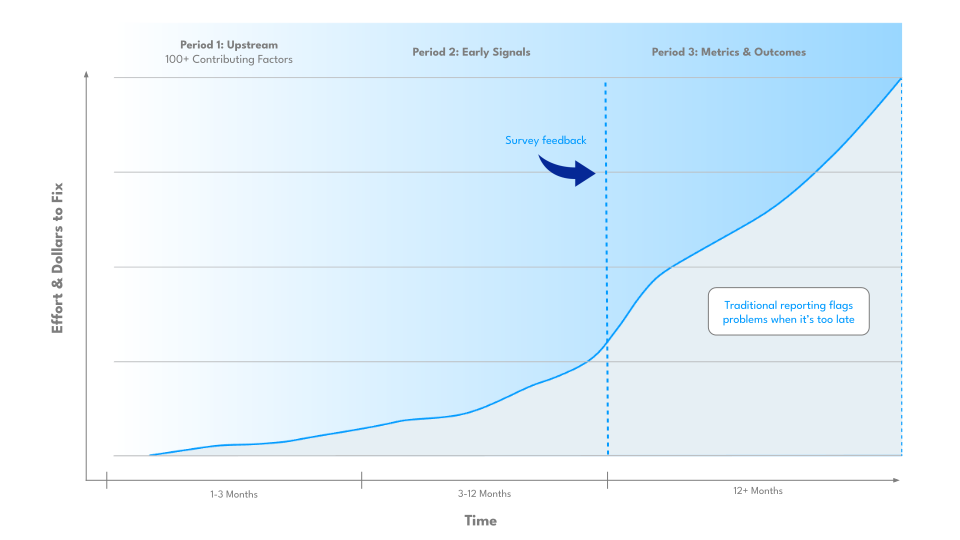
Period 1: Upstream
At the beginning of the cycle, hundreds of predictive signals begin to appear, signals that are often overlooked, invisible, or even celebrated:
- Rising after-hours documentation
- Escalating workload intensity
- Compensation patterns tied to future turnover
- Role tenure and life-stage signals that predict vulnerability
- Staffing and scheduling dynamics that quietly increase strain
This is where we still have options.
Period 2: Early Signals
Before resignation letters:
- Burned-out clinicians become twice as likely to quit
- Physicians signal intent to reduce hours at 3x the rate of prior years
- Patient complaints increase
- Staff complaints surface in pockets, not headlines
At this stage, intervention is still targeted, human, and effective.
Period 3: Metrics + Outcomes
This is where surveys live. By the time issues show up here, the damage is already visible – and costly:
- Productivity loss, as burned-out clinicians work less efficiently and disengage from care
- Surprise resignations that disrupt teams, schedules, and patient access
- Declining patient experience tied directly to clinician burnout and disengagement
- Increased patient harm as exhaustion and depersonalization raise error risk
- Compliance and malpractice risk linked to burnout and depression
- Presenteeism – clinicians physically present but cognitively depleted
- Toxic culture that accelerates turnover and erodes trust
This is the most expensive place to discover a problem, when options are limited, and costs are unavoidable.
What Changes When We Act Earlier
When we catch risk upstream:
- Resignations are prevented, not explained away
- Financial losses are avoided, not absorbed
- Workforce stability becomes intentional
- Care quality is preserved without heroic effort
- Leaders move from reacting to leading
The curve flattens.
The cost doesn’t explode.
The people stay.
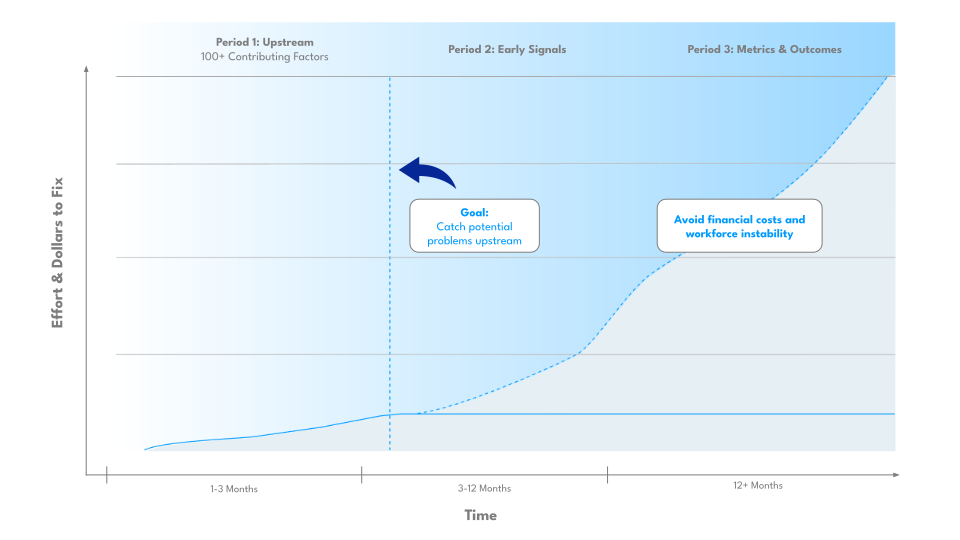
This lifecycle view aligns closely with the CDC’s Impact Wellbeing™ Guide – developed in partnership with the Dr. Lorna Breen Heroes’ Foundation – which explicitly calls on healthcare organizations to stop waiting for lagging indicators and start measuring early signals of distress.
The Difference Isn’t More Data
It’s Earlier Truth
We don’t need another retrospective report telling us we lost good people. We need visibility into the months when we could have kept them.
Surveys will always have a role. But if we rely on them alone, we’re agreeing to learn the truth too late.
But how do we start earlier? With Clinician Retention Intelligence (CRI). CRI is a new category of healthcare technology that predicts which clinicians are at risk of leaving, uncovers the root causes, and provides actionable guidance to prevent unexpected resignations – before it disrupts care or drains resources.
Unlike traditional HR or workforce tools, CRI solutions turn hospitals’ own operational and clinical data into proactive insights that protect patients, stabilize teams, and safeguard organizational performance.
A resignation is not typically a sudden event. It’s the final metric in a long, measurable process. The opportunity lies in understanding that process early and intervening before the outcome is inevitable.