
Leaders from MD Anderson, SSM Health, and HealthPartners outlined how clinician wellbeing succeeds when treated as a strategic, enterprise-wide priority embedded in operations, HR, and quality, rather than a standalone “program.”
They emphasized cross-functional influence over reporting lines, leveraging existing organizational strengths, and adopting proven frameworks (e.g., National Academy of Medicine, AMA) to align language and actions.
Effective leaders act as horizontal integrators, stay curious, and translate clinician voice into practice-environment improvements using quality improvement methods. Success is measured through integrated survey metrics, retention and engagement data, process measures, qualitative feedback, and cultural signals (e.g., leaders adopting wellbeing language and practices).
They cautioned against vendor-first, siloed approaches, urged celebrating wins to sustain momentum, and shared tactics for partnering with operations, HR, and GME to tailor support by role and career stage. The panel framed wellbeing as both a cultural driver and a risk mitigator for quality, safety, and financial performance.
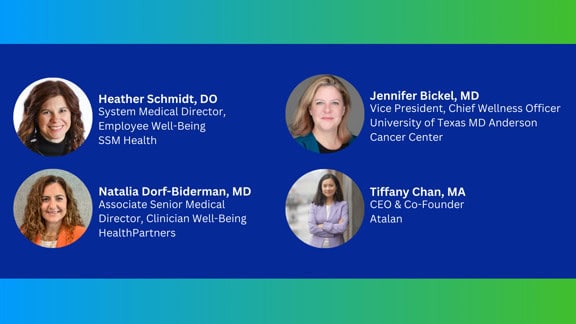
Speakers
Tiffany Chan, MA, CEO & Co-Founder, Atalan
Heather Schmidt, DO, System Medical Director, Employee Well-being, SSM Health
Jennifer Bickel, MD, FAAN, Vice President, Chief Wellness Officer, University of Texas MD Anderson Cancer Center
Natalia Dorf-Biderman, MD, Associate Senior Medical Director, Clinician Well-Being, HealthPartners
“Healthcare was not built with wellbeing in mind, so we're having to retrofit the entire system.”
Key Takeaways
1. Operationalize Wellbeing: Treat clinician wellbeing as a strategic, organization-wide goal embedded in core operations (not a standalone “program”), leveraging existing infrastructures like quality improvement, HR, safety, and operations to drive cross-functional execution.
2. Align Frameworks Systemwide: Align leadership around a proven framework (e.g., NAM, AMA) to create a shared language and roadmap, then translate clinician voice into system changes by using bidirectional listening channels and embedding accountability across teams.
3. Balance Success Metrics: Measure success with a balanced scorecard: validated survey items (e.g., AMA organizational biopsy), retention and engagement metrics, participation/process measures, qualitative feedback, and cultural signals (leaders adopting wellbeing language and practices).
4. Leverage Cross‑Functional Partnerships: Build influence through partnerships and curiosity. Map what’s already working (EAP, leadership development, safety, peer support), horizontally integrate efforts, and position wellbeing as a mitigator of organizational risk (turnover costs, quality, access, safety).
5. Celebrate, Iterate, Sustain: Sustain momentum by celebrating wins visibly (e.g., showcasing “making waves” stories, executive recognition, onboarding signals of culture), tailoring support to distinct groups like residents via collaboration and targeted communication, and continuously iterating via quality improvements.